


Fifteen months ago, I was calculating what 75 shares of Hims & Hers Health (HIMS) could be worth if everything went right.
Now I’m calculating how much pain I can tolerate if things keep going wrong.
I started buying around $19 in November 2024. I watched it run. I watched it hit $70. Twice I had real profits sitting there.
Twice I did nothing.
Today the stock is $15. I’m down 39%. And I’m feeling every bit of it.
Because this hasn’t been a gentle pullback. It’s been one headline after another.
Regulators circling. Powerful enemies taking notice. A stretch where it feels like half of Washington and Big Pharma decided my stock needed to be taught a lesson.
Shares are down more than 50% in a single quarter. More than 60% in six months. Momentum didn’t just stall, it hit me like a cousin slamming down a Draw Four at a cookout.
This is the part nobody brags about.
This is the life of a long-term investor.
This is the risk that comes with picking individual stocks.
This is the peril of never taking profits when the screen is glowing green and your conviction feels bulletproof.

Hims had been riding a wave. Its recent growth leaned heavily on high‑demand treatments, including certain weight‑loss medications. Revenue and enthusiasm were climbing.
Then scrutiny hit.
First, Amazon’s online pharmacy entered the chat as a direct competitor, expanding its offerings in November 2024 that threatened to cut into Hims’ business.
That alone made many investors run. Things have only gotten worse.
Last week, Novo Nordisk filed a lawsuit against Hims, claiming its weight‑loss drug strategy infringed on its patents and harmed its business.
Then the company was referred to the U.S. Department of Justice, amid concerns that its plan to mass-market a low-cost compounded weight-loss drug might violate federal law. The DOJ could pursue civil or even criminal enforcement if violations are found.
A drawn-out court battle could cripple the company. A quick loss would be just as devastating to Hims’ profit margins.
Oh yeah, Hims founder and CEO Andrew Dudum tweeted a 👀 emoji in October, as retail investors were hyping the stock — and then sold a sizable block of shares shortly after, frustrating many holders.
I had numerous chances to exit. For now, I’m weathering the storm.
Of course, none of this should have been a surprise. These risks were always there, quietly waiting in the background. I just hadn’t felt them yet.
When you invest in a company trying to shake up an industry, the wins can be huge. The pushback can be just as intense — and when it arrives, it stings more than you can imagine.

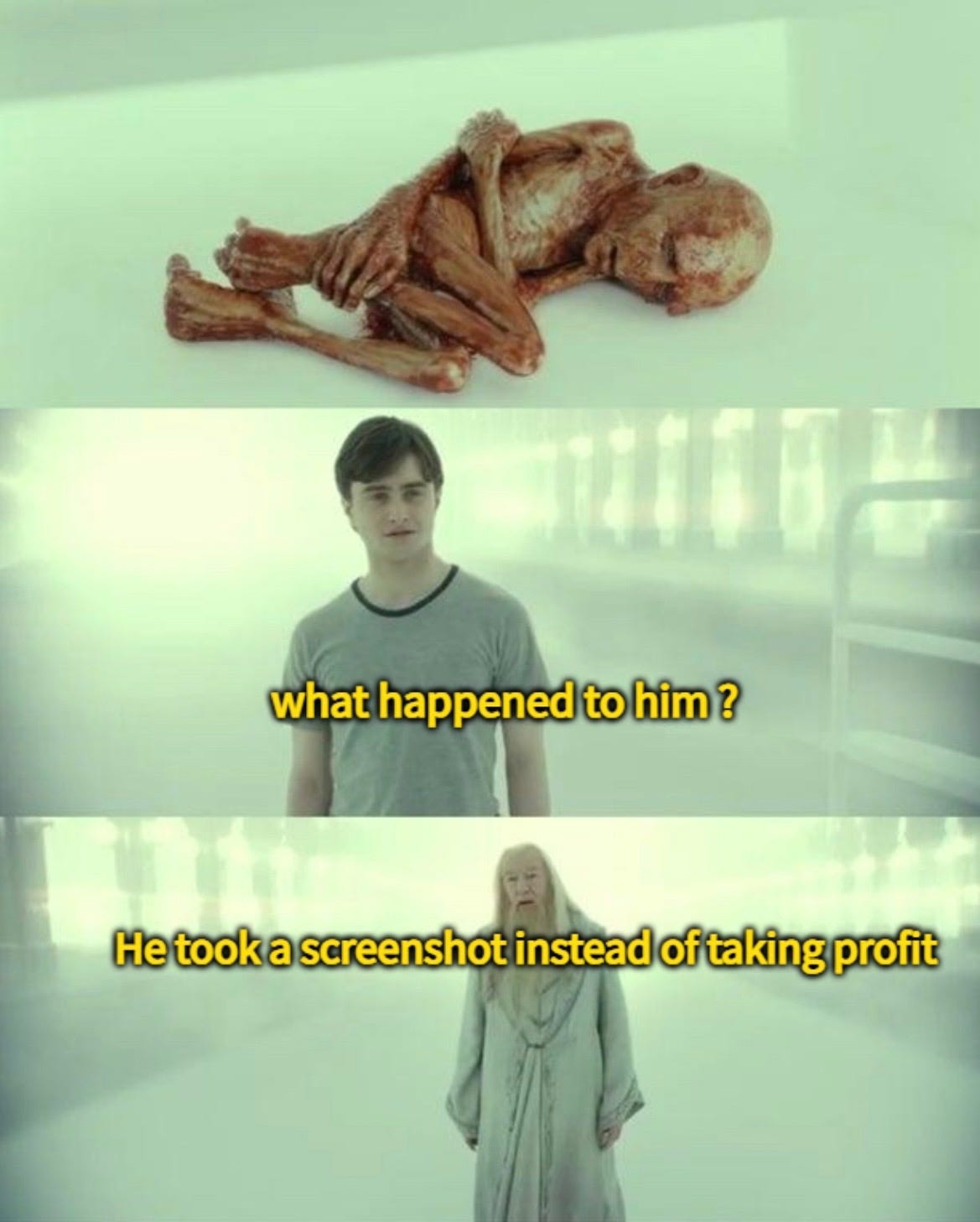
I’ve been on a rollercoaster with this position. I started buying around $19 in November 2024. The stock shot up to about $60. I even took a screenshot to savor the unrealized gains.
By April 2025, it had pulled back to the $20 level, a 220% unrealized gain wiped out, leaving me nearly flat.
Since then, I’ve added 58 more shares. Today, that same position shows an unrealized loss of nearly $2,500.
Why didn’t I take any profits? Because I believed in the future of telehealth, and my emotions tricked me into thinking $100 per share was just around the corner. I never want to be in the stock that keeps running while I sell too early, but now I’ve also lived the pain of never selling at all.
Now all I can do is hope — against common sense, really — that Hims’ earnings report on Monday brings some clarity, maybe even a little relief.
I’ve made a few dollars over the past two weeks buying put options on Hims in anticipation of the stock continuing to fall. Nowhere near the $7,200 unrealized profit I had when Hims hit its all-time high just below $73 last February.
The lessons are brutal but clear.
Individual stocks can soar. And they can tank just as fast.
Conviction is no shield against headlines, lawsuits or regulatory fire. Never taking profits feels heroic when everything’s green, but it can leave you staring at losses you swore you’d never see.
I’ve paid tuition in real dollars and emotional wear and tear. I’ve also gained a firsthand education in market swings, risk and human behavior. Lessons no article or podcast could teach as vividly.
So yes, I’m down. Yes, it stings.
But I’m still here. Still watching. Still learning.
Because that’s what being a long-term investor really means.

Why I’m lighting up my portfolio with weed stocks

I’ve spent a substantial $1,902.92 on marijuana this year.
Unlock my Q1 investment playbook!

Editor’s note: This one’s a little different — and a lot more personal. In my first exclusive column for paid subscribers, I’m pulling back the curtain on every dollar I invested in Q1, revealing key takeaways and lessons learned to help you navigate your own financial journey.
Woof, this sounds like an absolutely awful time. VT and chill for me, haven't checked my portfolio in months aside from making contributions each month.